![[personal profile]](https://www.dreamwidth.org/img/silk/identity/user.png)
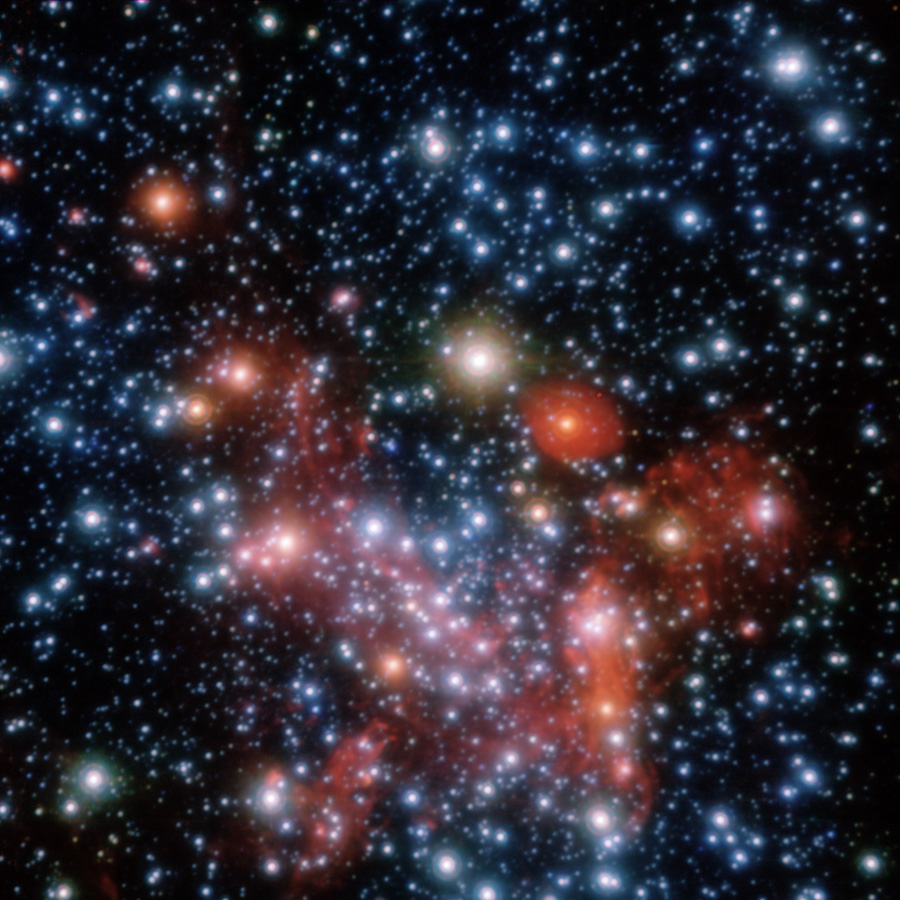
Apod this morning has a picture (here, if you don't subscribe http://antwrp.gsfc.nasa.gov/apod/image/0812/mwcenter_eso.jpg ) of the center of the galaxy. The text from today's cover page says "...astronomers patiently measured the positions of the stars over time, following one star, designated S2, through a complete orbit as it came within about 1 light day of the center of the Milky Way. Their results convincingly show that S2 is moving under the influence of the enormous gravity of a compact, unseen object -- a black hole with 4 million times the mass of the Sun. "
Several things are undeniable. Whatever is at the center is enormous, it does not continually give off infra-red light as a star might, and it's far too small to keep the galaxy together by means of gravity alone. I would have expected the object at the center to be at least a thousand times more massive, and I never assumed like the current theory that gravity was the end all and be all of galactic forces. With this result expect to hear more and more about 'dark energy' and searches for 'dark matter' which are a polite way of summarizing, 'we don't know what the heck we're talking about yet.'
Several things are undeniable. Whatever is at the center is enormous, it does not continually give off infra-red light as a star might, and it's far too small to keep the galaxy together by means of gravity alone. I would have expected the object at the center to be at least a thousand times more massive, and I never assumed like the current theory that gravity was the end all and be all of galactic forces. With this result expect to hear more and more about 'dark energy' and searches for 'dark matter' which are a polite way of summarizing, 'we don't know what the heck we're talking about yet.'
![[identity profile]](https://www.dreamwidth.org/img/silk/identity/openid.png)
From:
no subject
Heh. Awesome. I get most of my "science" from Trek and Stargate anyway, so this makes perfect sense to me ;)
From:
no subject
Iz so cool.
From:
no subject
Hmm. Maybe it's a typo, & they meant 4 billion! Or maybe that central object doesn't have to keep the galaxy together by itself; its gravity is just added to that of all the other matter in the galaxy to keep it together.
"'dark energy' and searches for 'dark matter' which are a polite way of summarizing, 'we don't know what the heck we're talking about yet.'"
My understanding is that dark matter just means any matter that doesn't give off its own light, like planets, moons, asteroids, comets, & an "etc." that includes huge gas & dust clouds, & that the issue is that calculations of the total mass of the universe couldn't be accounted for by the visible stars, quasars, etc. & must include more dark matter than had been thought. I think I've even read some speculation that there could be so many neutrinos in the universe that despite their nearly nonexistent mass they could be making a substantial contribution to the total. So for dark matter, it's not so much that we don't know "what" as it is that we don't know how much of which "what" we're talking about. Dark energy, on the other hand...yeah, nobody seems to have any idea of what that is!
From:
no subject
Personally I think the idea that there are enough neutrinos to make up the mass difference is grasping at straws. They pick something that's difficult to detect and assume that must be the answer. If we are 'swimming' through that many particles (enough to total tens of billions of suns worth just within the galaxy) then other, much stranger theories of how the galaxy holds together are just as likely to be correct.
On the other hand a central black hole billions of times the mass of the sun would have gone a long way towards vindicating Einstein.
I did the calculations once for a black hole 1 billion times the mass of the sun and determined that a star in orbit at one light year from the black hole would be traveling around 3/4 the speed of light. The effects of relativity on such a star would be very noticeable. The star they found is about one light day away and relativity is surely noticeable in its orbit. The fact they were not jumping up and down with glee about observed effects of relativity on it makes me guess the quoted mass of the central black hole is not a typo.
From:
no subject
So I did read that about the neutrino hypothesis!
And how do you do those calculations? What do you plug into them besides the mass of the black hole?
From:
no subject